
AUTOEQUIPS Camera Monitor System: Regulatory Shift and Vision Expansion for Commercial Fleets
Oct 8, 2026
Shenzhen, Guangdong Oct 8, 2026 (Issuewire.com) - Regulatory and Operational Drivers of the CMS Transition
For engineering and procurement teams at commercial vehicle OEMs, indirect vision is no longer a component-level decision. It touches type approval documentation, cockpit HMI layout, in-vehicle network architecture, and, ultimately, the length of a vehicle development program. That is why the mirror -- arguably the oldest safety device on a truck or bus -- has become one of the most actively re-engineered parts of the modern cab.
The limitations of conventional mirrors are familiar to anyone who has driven a heavy vehicle. Fixed glass leaves blind spots that no adjustment fully eliminates, especially along the near-side of a long trailer or around the front corner of a city bus. Rain, snow, fog and condensation blur the image when visibility matters most, and at night the headlights of a following vehicle can wash out detail. Bulky housings add drag and wind noise at highway speed, raising fuel or energy consumption, and because they protrude, they get clipped at bus stops and on narrow streets -- a recurring, often underestimated maintenance cost. These pain points are pushing fleets and OEMs to treat a Camera Monitor System as a functional replacement rather than a styling option, and explain much of the demand flowing toward experienced suppliers, including established China Camera Monitor System Manufacturer partners serving global truck and bus platforms.
Regulation has accelerated the shift. UN R46 has progressively defined the technical and type-approval requirements for camera-monitor devices as indirect vision systems, giving OEMs a clear path to replace Class II, IV, V and VI mirrors. The EU General Safety Regulation has in parallel raised expectations around field of view and vulnerable road user protection, creating conditions for a Camera Monitor System to work alongside BSIS, MOIS and reversing detection rather than in isolation. Together, these developments are moving CMS from premium optional equipment toward broader platform adoption.
AUTOEQUIPS has been preparing for this transition for some time. Founded in 2000, it develops commercial vehicle safety solutions from bases in Huizhou and Taiwan totaling roughly 32,000 m², with close to 100 patents and processes aligned with ISO 26262 and ISO/SAE 21434. Its upgraded CMS mirror replacement system is designed to meet UN R46 requirements across the range, validated by more than 269 million kilometers of accumulated road testing since 2019.
Traditional Mirrors vs. Camera Monitor Systems: A Paradigm Shift in Commercial Vehicle Vision Safety
Compared with a reflective glass surface, a camera-and-display architecture offers meaningful advantages in blind spot coverage, all-weather clarity, energy consumption, and the ability to extend into active safety functions.
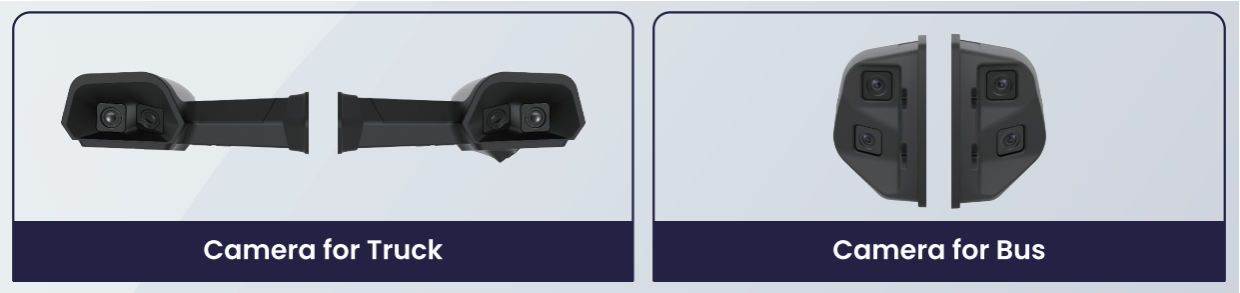
In terms of field of view, conventional mirrors are fixed in geometry and limited in angle. The AUTOEQUIPS CMS uses a dual-camera arrangement with wide-angle optical design, combining main view, wide view, close-side view and front close-range view configurations to cover the areas associated with Class II, IV, V and VI mirrors. The practical result is a reduction in blind zones along the rear flanks and immediately around the vehicle body.
Weather and night performance is the second clear differentiator. Glass mirrors collect rain and condensation and offer no defense against glare from following headlights. AUTOEQUIPS camera units integrate PTC / resistive-film automatic heating for defogging and de-icing, and pair anti-glare treatment with night-sensitive imaging to keep the displayed image usable when conditions deteriorate.
Aerodynamics and running costs complete the picture. Bulky mirror arms generate drag and noise; the compact exterior camera housings sit closer to the body, helping lower drag and energy use while reducing the likelihood of impact damage in tight lanes or at bus platforms.
In bus and truck applications, the displays are typically mounted near the interior A-pillars, close to the driver's natural sightline, so that checking the rear view requires a shorter glance. For operators, the combined effect is a safety improvement that also supports cost control.
Image Quality and Optical Technology: True High-Definition Vision Under Complex Lighting
A Camera Monitor System is only as good as the image it presents. Seeing clearly -- and seeing accurately -- is where optical coating and image processing work together.
AUTOEQUIPS lenses use high-end anti-reflection coating that reduces surface reflectance to below 1% while achieving optical transmittance above 90%. Lower surface reflection means fewer ghost images, and when combined with HDR, exposure control and downstream image processing, it improves visibility in direct sunlight and against strong light sources at night.
The imaging chain delivers 1920--1280 resolution at 60 fps with 120 dB high dynamic range, and includes LED Flicker Mitigation (LFM) to suppress the flicker and banding that pulsed LED headlamps and traffic signals otherwise produce on screen. An AI-ISP layer handles the harder cases: the extreme contrast at tunnel entrances and exits, and low-light scenes down to around 0.01 lux, with real-time exposure adjustment and noise reduction aimed at true-to-life color reproduction.
In practice, this is what prevents a truck driver from facing a blown-out white frame when exiting a tunnel, or a solid black patch when a following vehicle switches to high beams -- highlights are held back while shadow detail is lifted. The processed image is presented on displays rated around 1,000 cd/m² for sunlight readability, with stable, low-latency output consistent with R46 expectations.
Automotive-Grade Reliability and Dual-Camera Redundancy: Built for Extreme Environments and Heavy-Duty Operations
Commercial duty cycles are unforgiving, and hardware durability plus signal continuity matter as much as image quality. Any serious Camera Monitor System Manufacturer has to prove both.
The camera units carry IP69K protection, allowing high-pressure wash-down, and operate across a -40 °C to +85 °C range. High-hardness optical glass is used at the lens surface to resist sand and grit impact as well as abrasion from automatic car-wash brushes.
Signal integrity relies on automotive-grade FAKRA connectors and GMSL2 high-speed serial transmission, supporting long cable runs with low latency and strong electromagnetic immunity, validated against CISPR 25 Class 3 and ISO 16750 vibration testing at 5G levels.
Redundancy is designed in rather than added on. Each side module uses a dual-camera architecture, so if one optical channel behaves abnormally, the system can maintain core field-of-view output instead of exposing the driver to a blind spot through a single point of failure.
From long-haul trucking in sub-zero regions to hot, humid city bus operation, AUTOEQUIPS reports continuous stable operation exceeding 10,000 hours -- the kind of figure fleets care about, because it correlates with fewer vehicles off the road waiting for parts.
Intelligent Integration and Full-Service Support: Enabling Digital Upgrades for OEMs and Fleets
Replacing mirrors is the starting point, not the destination. The broader value lies in perception, system-level interaction, and lifecycle support.
The platform embeds an AI blind spot detection algorithm capable of identifying vehicles, pedestrians, and cyclists at distances up to approximately 35 meters in complex road environments. FOTA support covers remote firmware updates, log upload, and health monitoring, which helps fleets reduce maintenance overhead and diagnose issues without a workshop visit.
Equally important for OEMs is the engineering relationship. As a Camera Monitor System Manufacturer working directly with vehicle programs, AUTOEQUIPS supports pre-sales solution design, deep OEM customization and global after-sales response, and has built long-standing cooperation with a number of well-known commercial vehicle brands. During UN R46 and GSR type approval work, that support extends from HMI interaction design through to CAN bus protocol integration -- the details that usually consume schedule. Shortening that path helps partners bring compliant models to market sooner.
Conclusion
As regulations tighten and commercial vehicles grow more software-defined, CMS is moving steadily from a premium or niche option toward wider deployment across truck and bus platforms. AUTOEQUIPS continues to build on its technology base spanning AHD to LVDS architectures since 2019, automotive-grade quality discipline, UN R46-aligned compliance and 269 million kilometers of road validation.
To learn more about commercial vehicle CMS mirror replacement solutions and OEM customization services, please visit the AUTOEQUIPS official website: https://www.autoequips.com.

Media Contact
AUTOEQUIPS TECH CO., LTD.
+86 0755 8601 6485
Room 04/11F, Block C, Wanhai Building, No.1031 Nanhai Avenue, Nanshan District, Shenzhen, Guangdong, China
Source :AUTOEQUIPS TECH CO., LTD.
This article was originally published by IssueWire. Read the original article here.
More News

Ontario doctors demand apology from province for letters flagging high number of days worked, patients seen
The Ontario Medical Association is looking for an apology from the province, after it says 'hundreds' of doctors received letters recently stating they were working too many days or seeing too many patients. A health ministry spokesperson says the letters are not an assumption of inappropriate billing.

Airport Eats: Where to Eat and Drink at Portland International Airport
Portland International Airport’s $2.15 billion transformation brings travelers craft cocktails, wood-fired pizza, Oregon seafood and exceptional coffee, with local restaurants turning PDX into an unexpectedly delicious destination before departure. The post Airport Eats: Where to Eat and Drink at Portland International Airport appeared first on Business Traveller.

Tanzania to Host World Travel Awards Grand Final on December 12th.
Tanzania is preparing to take centre stage on the international tourism calendar after being officially announced as the host destination for the 2026 World Travel Awards Grand Final, which will take place on December 12th at the stunning The Four Seasons Safari Lodge Serengeti, a premier 5-star luxury property nestled deep within the Central Serengeti National Park in Tanzania.

Morocco takes centre stage in London through the art of Winston Churchill
The Ambassador of the Kingdom of Morocco to the United Kingdom and the Moroccan National Tourist Office (MNTO) hosted an exclusive reception at the prestigious Wallace Collection in London, in connection with the exhibition Winston Churchill: The Painter. The initiative reflects MNTO’s ambition to place culture and internationally renowned figures at the heart of Morocco’s global tourism promotion. Coinciding with World Travel Market (WTM) London, the Moroccan National Tourist Office selected one of Britain’s most distinguished art institutions, the Wallace Collection, as the setting for an evening dedicated to the exhibition Winston Churchill: The Painter.

Naher Osten: Airlines setzen Flüge nach Dubai weiter aus
Die europäischen Airlines haben die Wiederaufnahme nach Dubai erneut verschoben. Condor setzt die Verbindungen in das Emirat ganz aus. The post Naher Osten: Airlines setzen Flüge nach Dubai weiter aus appeared first on Business Traveller.

Sri Lanka Sets Sights on 4-5 Million Visitors by 2030 at WTM London 2026
Sri Lanka Tourism Promotion Bureau (SLTPB) revealed the island’s latest tourism developments at World Travel Market (WTM) London 2026, taking place from 3-5 November at ExCeL London. Led by the Deputy Minister of Tourism, Hon. Prof. Ruwan Ranasinghe, the Sri Lanka delegation hosted a lunch and press conference on 4 November, sharing updates on new air connectivity from the UK, the country’s national tourism strategy and its priorities for 2027.

Quito Concludes Its European Promotional Tour with Its Own Stand at WTM London 2026
Quito is participating at World Travel Market (WTM) London 2026, taking place from 3 to 5 November at ExCeL London, with its own stand (N8-314), where it is showcasing its tourism offering and strengthening its positioning among international travel industry professionals. The Ecuadorian capital is using this global platform to reinforce relationships with tour operators, travel agencies, specialised media and strategic partners across Europe’s key source markets.

Qatar Airways Inaugurates Flights to Venezuela and Colombia
The airline inaugurates twice-weekly flights linking Doha, Bogotá and Caracas, becoming the first Gulf carrier to serve Venezuela while expanding connections between South America, Asia and the Middle East. The post Qatar Airways Inaugurates Flights to Venezuela and Colombia appeared first on Business Traveller.

Travel Around Paris And We'll Guess Your Relationship Status
Is there any city that's more romantic? View Entire Post ›

Broadcasters Julia Bradbury and Kate Humble extol virtues of the great outdoors during WTM London
Broadcasters Julia Bradbury and Kate Humble urged tour operators at WTM London to think carefully about how they target different audiences and the language needed to woo the right customers. Speaking yesterday during sessions on the Wanderlust Stage, they both extolled the virtues of the great outdoors and getting off the beaten track – especially if it encourages travellers to put down their phones and fully experience destinations.

Visit Qatar Launches Two-Night Doha Stopover Offer for UK Customers
Visit Qatar announced the launch of Stopover Your Way (Enjoy Two Nights on Us) at World Travel Market (WTM) London, offering eligible UK travellers two nights’ accommodation at participating four-star hotels across Qatar. Developed in partnership with Qatar Airways and Discover Qatar, the promotion encourages travellers to turn their journey into an opportunity to discover all that Qatar has to offer, from its rich cultural heritage to its beaches, desert adventures, museums and vibrant culinary scene. There are a number of participating four-star hotels, and customers have flexible options to upgrade or extend their stay.

String duo Sol Gabetta and Patricia Kopatchinskaja impress in theatrical Hong Kong recital
Seldom is the idiom to show up “with bells on toes” taken literally, but that is exactly what Moldavian-Austrian-Swiss violinist Patricia Kopatchinskaja and Argentine cellist Sol Gabetta did at their recital at Hong Kong City Hall on November 2. Classical music boundaries have no place in the pair’s playbook, and their theatrical entrance for the last leg of their Asian tour – each from opposite sides of the stage, dressed in bold colours and wearing slip-ons with bell-lined toes – was a clear...
YOUR NEWS, OUR NETWORK.
Do you have Great News you want to tell the world?
Be it updates about your business or your community, you can make sure that it’s heard by submitting your story to our network reaching hundreds of news sites across 6 verticals.